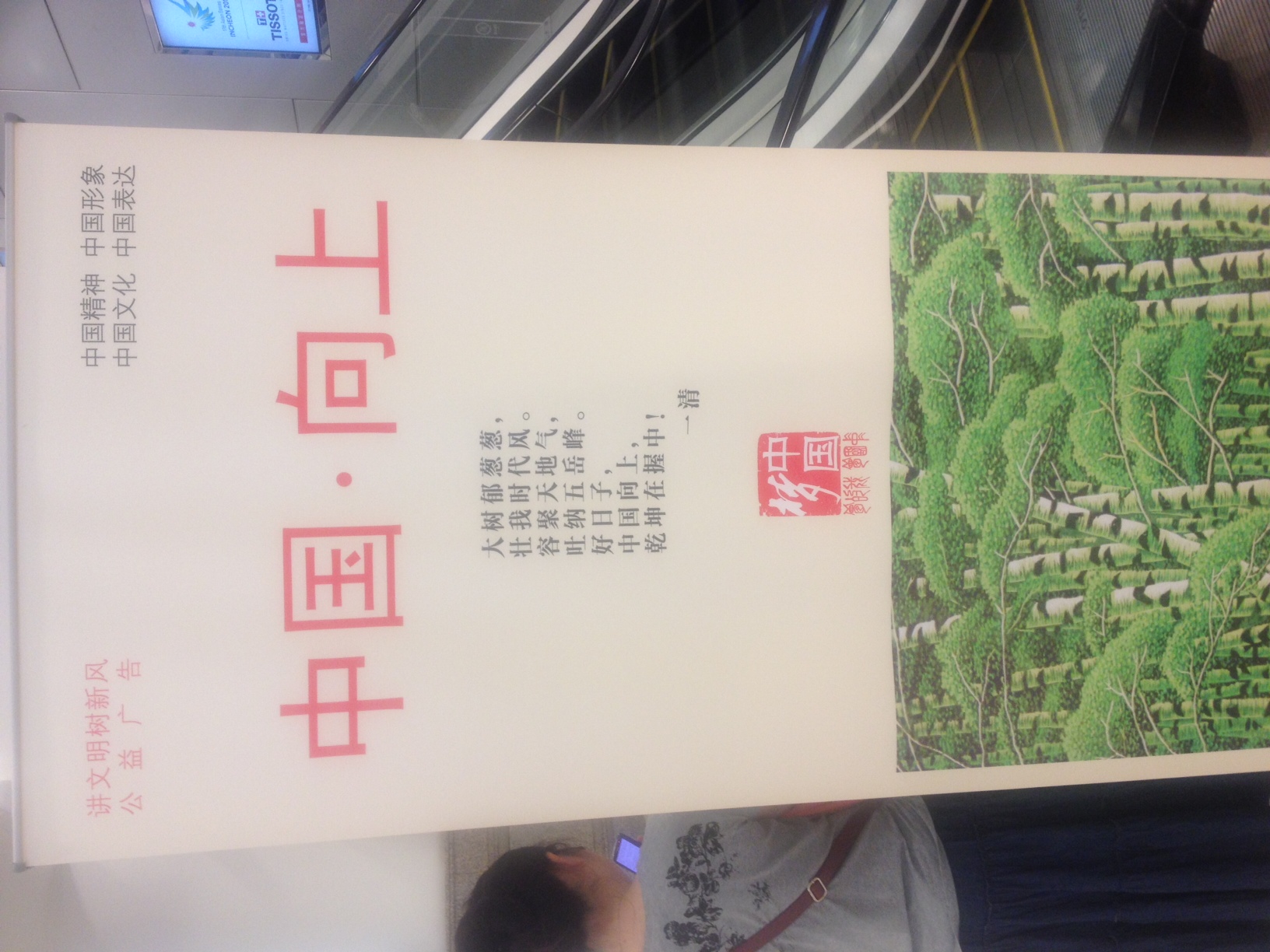
As part of Mr Xi’s current China Dream campaign, I’ve seen a lot of these kinds of poems plastered all over the subways.
Here’s an interesting one:
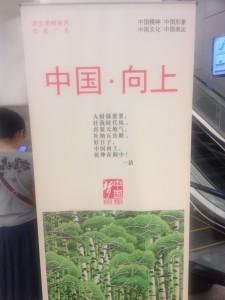
《ä¸å›½Â·å‘上》
å¤§æ ‘éƒè‘±è‘±
壮我时代风
容èšå¤©åœ°æ°”
å纳五岳峰。
好日å,
ä¸å›½å‘上,
ä¹¾å¤åœ¨æ¡ä¸ï¼
“China Rising”
The great tree grows lush and green
Strong in the winds of our age
Uniting the power of heaven and earth
Breathing the air upon China’s great peaks.
These are good days,
China is rising
The world is within our grasp!
+++
What a difference stopping to read these poems makes! You’d think it’s just some silly stuff about trees, but no, it’s a tree that’s going to take over the world. Whoa.
posted by ferret at 6:10 pm
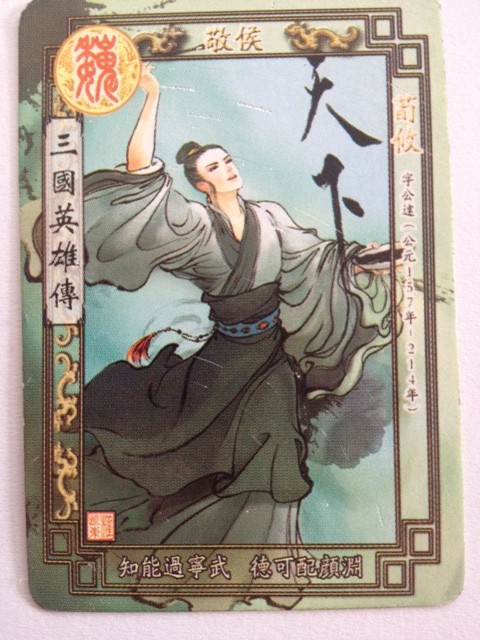
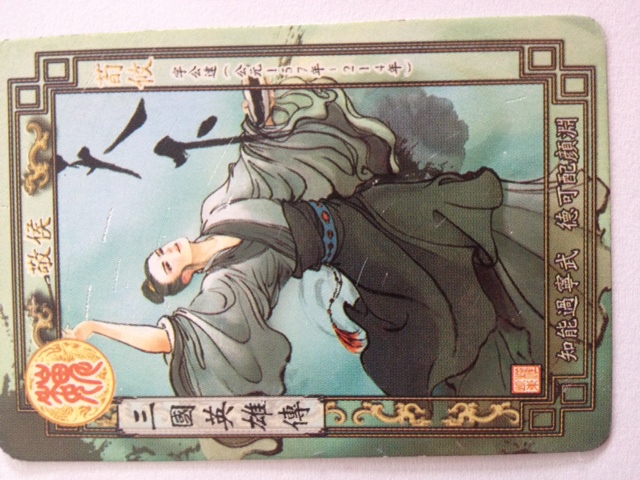
So… I found a card on the ground for one of those Three Kingdoms card games the kids seem to be playing these days. I didn’t recognize the character on the card, so I thought I’d dig a bit deeper.
First of all, I was surprised to find out that this is supposed to be a man. He looks super girly. His name is Xun You, who was one of the head military strategists for Three Kingdoms‘ bad boy, Cao Cao. I suppose that he wasn’t really a fighter, per se, so looking feminine isn’t such a big deal. The inscription at the bottom of the card reads (originally in traditional characters, but I’ve switched the script to make my life easier):
知能过å®æ¦  德å¯é…颜渊
Knowledge surpassing Ning Wu, character on par with Yan Yuan
I guess these have something to do with playing the card game it goes with.
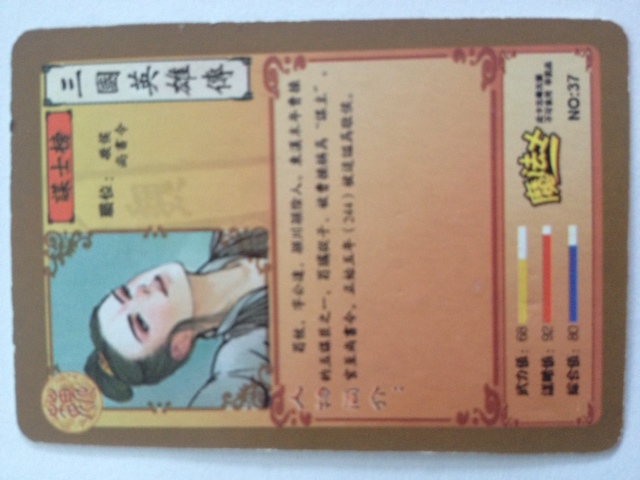
Now to the back!
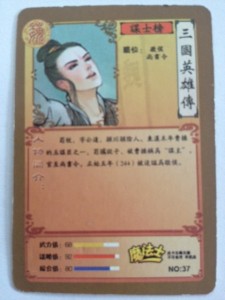
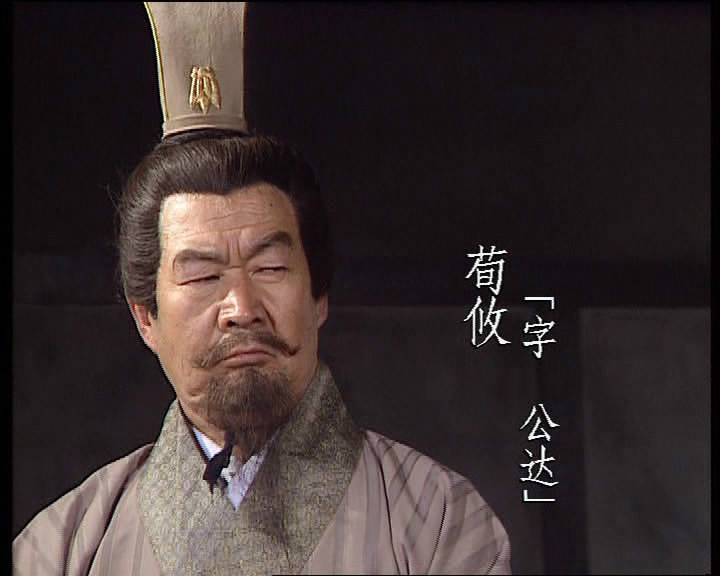
There’s a bit about what we know about him historically, etc. Most of interest to me is bottom where there’s stats for his “military worth” (æ¦åŠ›å€¼), his “strategy worth” (谋略值) and his “overall worth” (综åˆå€¼). He’s the best in terms of “strategy worth” (92/100) as you’d expect. Man, he really looks like a lady in this picture though, doesn’t he? He doesn’t always look like this though. Here he is in the old school 80s TV version of Three Kingdoms:
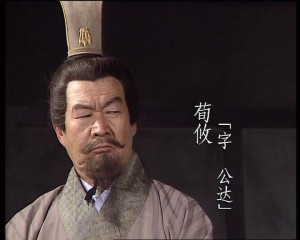
Rock out, Xun You.
posted by ferret at 5:37 pm
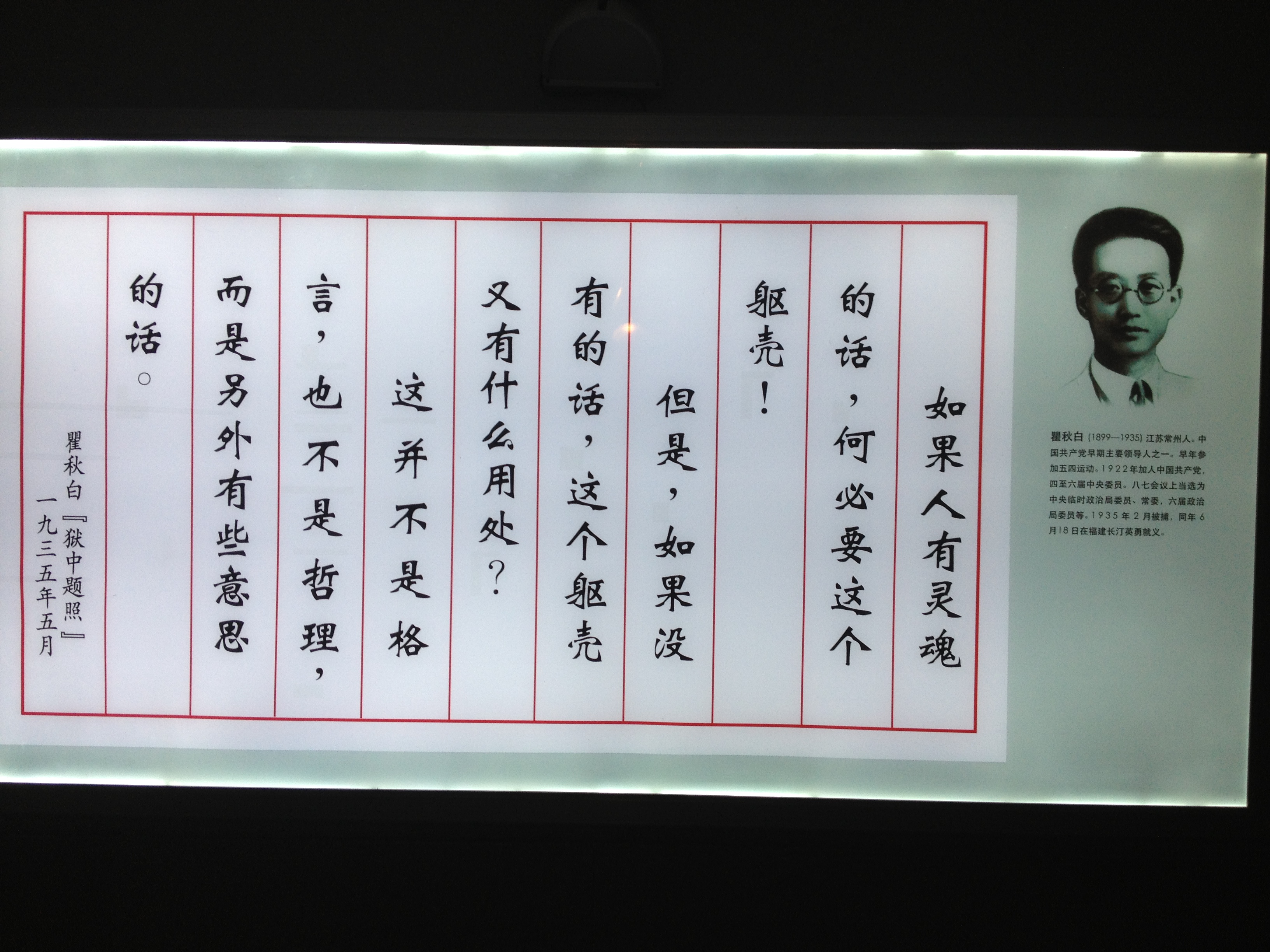
In the Longhua Martyr’s Cemetery there’s a tunnel full of all manner of revolutionary sayings, some of them communist, some just generally pushing the reader to fight the good fight.
This one seemed interesting enough:
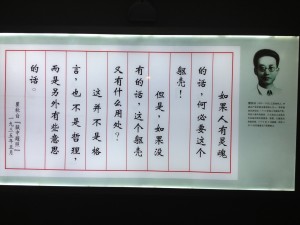
如果人有çµé‚çš„è¯ï¼Œä½•å¿…è¦è¿™ä¸ªèº¯å£³ï¼
If one has a soul, then one must have a body!
但是,如果没有的è¯ï¼Œè¿™ä¸ªèº¯å£³åˆæœ‰ä»€ä¹ˆç”¨å¤„?
However, if one doesn’t have a soul, then what good is a body?
这并ä¸æ˜¯æ ¼è¨€ï¼Œä¹Ÿä¸æ˜¯å“²ç†ï¼Œè€Œæ˜¯å¦å¤–有些æ„æ€çš„è¯ã€‚
This isn’t just some saying, nor is it a philosophy, it’s something else altogether.
– Qu Qiubai
posted by ferret at 10:45 pm
It’s come to be the opinion of this humble Ferret that cultural exchanges in China are generally plagued by a kind of Orientalism, a perception of an intractable Other, or a perceived mystery that prevents people from having a meaningful exchange. This happens on both sides of the aisle. Foreigners feel that there are some things about China that are impossible to know; Chinese feel as if there are some things foreigners will never understand. And vice-versa.
Recently, I had a rather truthful exchange. A model perhaps for all future cultural exchanges:
[Ferret walks into a bathroom at Sichuan restaurant. He pees a urinal, thinking perhaps far too much about his expat, Chinese dilettante status. Old Chinese Man walks in as he is zipping up. Old Chinese Man notices Ferret.]
Old Chinese Man
Hello!
Ferret
Hello!
Old Chinese Man
ä½ å¥½ï¼
Ferret
ä½ å¥½ï¼
All things exchanged! All things understood! A four-part exchange where every message is conveyed clearly to the other succinctly and straightforwardly. Oh, that it could be so easy!
posted by ferret at 12:01 pm
Your humble Ferret recently went to a banquet at a very fancy Cantonese restaurant and stuffed himself silly.
While eating some “hand-fried squid” (手炸鱿鱼), I noticed that they were sitting on a piece of paper with a Chinese poem written on it.
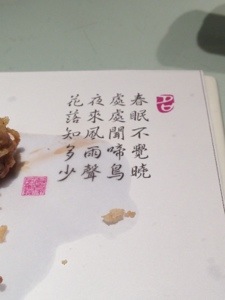
Having 干毒d a little too much wine, I attempted to read it ç¹ä½“å— and all in front of some Chinese folks. I did okay and only made a few mistakes, blustering my way through it like a 7 year old. But it didn’t really matter anyway. All the Chinese people there knew it by heart.
<春晓>
唕åŸæµ©ç„¶
æ˜¥çœ ä¸è§‰æ™“
处处闻啼鸟
夜æ¥é£Žé›¨å£°
花è½çŸ¥å¤šå°‘
"Springtime Awakening"
Meng Haoran (Tang)
A springtime sleep, day breaks without me knowing
Everywhere I hear birdsong
The night was full of the sound of storms
Who knows how many flowers have fallen?
(Apparently there is a political angle to all of this, i.e. flowers getting blown away in the night. I don't know what that had to do with fried squid. 炒鱿鱼 maybe?)
posted by ferret at 6:11 pm
…and I still can’t say the word for “city” properly.
posted by ferret at 1:21 pm
My girlfriend recently gave me a bamboo iPhone case made by a company called Cicada. On the box by way of explanation for their company, they included a Tang Dynasty poem:
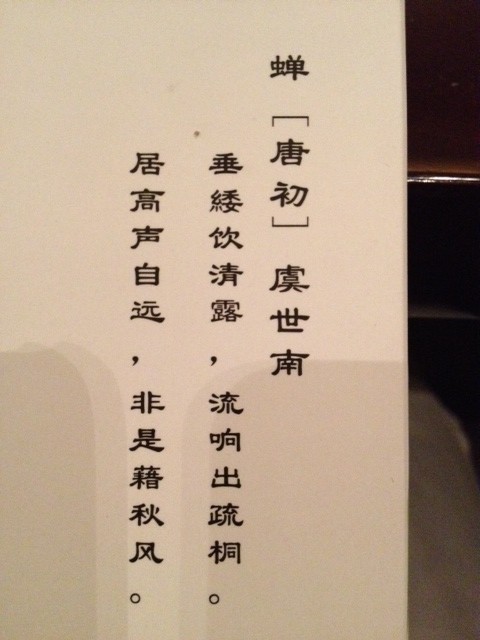
My translation:
“Cicada”
Yu Shinan [Early Tang Dynasty]
Hanging from a drooping branch drinking dew,
Its sound scatters though the phoenix trees.
Living high up it makes sounds that travel far,
Not relying on the fall wind to carry them.
Note: The last two lines of the poem are supposed to represent the idea that if you’re doing something good or you’re powerful, you don’t need to rely on the help of others to publicize it. The Baidu review of the poem has this to say: è‰å£°è¿œä¼ ï¼Œä¸€èˆ¬äººå¾€å¾€ä»¥ä¸ºæ˜¯è—‰åŠ©äºŽç§‹é£Žçš„ä¼ é€ï¼Œè¯—人å´åˆ«æœ‰ä¼šå¿ƒï¼Œå¼ºè°ƒè¿™æ˜¯ç”±äºŽâ€œå±…高â€è€Œè‡ªèƒ½è‡´è¿œã€‚è¿™ç§ç‹¬ç‰¹çš„æ„Ÿå—è•´å«ä¸€ä¸ªçœŸç†ï¼šç«‹èº«å“æ ¼é«˜æ´çš„人,并ä¸éœ€è¦æŸç§å¤–在的å‡è—‰. So I guess the idea is that these iPhone cases are supposed to be so sweet that word about them will get around without any help at all…
posted by ferret at 8:57 pm
[Ferret and his co-workers, Wolverine, Oriole and Chickadee are eating dinner at a Japanese noodle shop. Ferret‘s food arrives.]
WaitressÂ
石锅é¥ï¼å“ªä½çš„?
 Stone bowl rice! Whose is it?
Ferret
è¿™ä½çš„ï¼
This guy’s!
[Oriole and Chickadee both gasp! The Waitress serves the sizzling bowl of rice topped with meat and vegetables.]
Ferret
What? What’d I do?
Oriole
You are so rude!
Ferret
What? Why?
Oriole
You can’t call yourself ä½ (person).
Ferret
No?
Oriole
No. Just say 这是我的 (This is mine).
posted by ferret at 6:35 pm
[Ayi is cleaning Ferret‘s house. Ferret is on his way out the door when he notices Ayi‘s black baseball cap with the words “Hot and Sexy” written on it in pink. He feels he should say something.]
Ferret
è¿™æ˜¯ä½ çš„å¸½åå—?
Is this your hat?
Ayi
对的,我的帽å。
Yeah, it’s my hat.
Ferret
ä½ çŸ¥é“那个英文è¯æ˜¯ä»€ä¹ˆæ„æ€å—?
Do you know what those English words mean?
Ayi
ä¸çŸ¥é“。什么æ„æ€ï¼Ÿ
No. What do they mean?
Ferret
æ„æ€æ˜¯æ€§æ„Ÿã€‚
The meaning is “sexy”.
Ayi
[not sure what he’s trying to say]
什么?性噶?
What “xìnggá”?
Ferret
性感。
Sexy.
Ayi
性感ï¼çœŸçš„å—?
Sexy! Really?
Ferret
真的。
Really.
Ayi
那我ä¸åº”该戴啊ï¼
Then I shouldn’t wear it!
Ferret
但是大部分的ä¸å›½äººä¸çŸ¥é“是什么æ„æ€ï¼Œæ‰€ä»¥æˆ‘觉得没有问题。
But most Chinese people don’t know what it means, so I think it’s not a problem.
Ayi
å¯æ˜¯æˆ‘的客户都是外国人啊ï¼
But my clients are all foreigners!
Ferret
æ©ï¼Œæˆ‘-我ä¸çŸ¥é“。
Well, I- I don’t know.
[Ferret awkwardly makes for the door.]
我走了。
I’m going.
Ayi
å¥½çš„ã€‚è°¢è°¢ä½ å‘Šè¯‰æˆ‘å•Šï¼æ€§æ„Ÿï¼å•Šå‘€ï¼
Okay. Thanks for telling me! Sexy! Jeez!
posted by ferret at 1:37 am
Parturient

å–唼
(yóngshà )
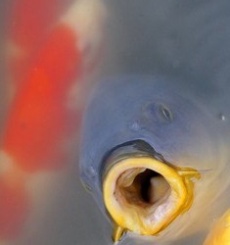
(For Chinese geeks, I found this word in å¾å¿—æ‘©’s poem 《ç§è¯ã€‹.)
posted by ferret at 12:04 am